
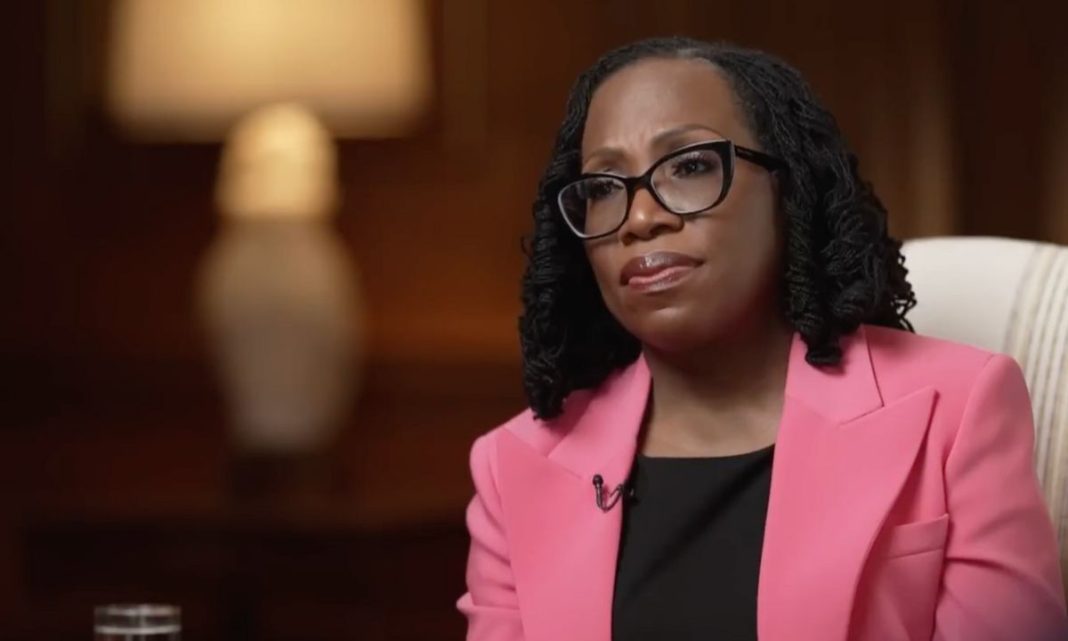

Jackson’s Ongoing Struggle to Define Basic Realities
Supreme Court Justice Ketanji Brown Jackson, who famously dodged defining “woman” during her 2022 confirmation by claiming, “I’m not a biologist,” appears no closer to clarity nearly four years later.
Her recent questioning during oral arguments in two pivotal women’s sports cases—West Virginia v. B.P.J. and Little v. Hecox—highlights a troubling reluctance to acknowledge straightforward biological distinctions.
In these cases, the ACLU is challenging state laws in Idaho and West Virginia that safeguard women’s athletics by excluding males, arguing such measures unconstitutionally discriminate based on s-x and gender identity.
She pressed West Virginia Solicitor General Michael Williams on perceived unfairness, stating: “For cisgender girls, they can play consistent with their gender identity, [for transgender girls] they can’t.”
Williams countered that this actually proves the law isn’t targeting transgender status but rather ensuring males don’t compete in women’s sports, explaining: “That’s useful evidence as to the lack of a transgender-based discrimination, because if the legislature were just sort of unsettled by the notion of transgender athletes, I think the answer would have been to bar them” from sports.
Flawed Inquiries Expose Jackson’s Disconnect in Key Exchanges
Delving deeper, Jackson challenged Idaho Solicitor General Alan Hurst on why the law doesn’t amount to discrimination based on gender identity, asking: “The law expressly aims to ensure that transgender women can’t play on women’s sports teams, so why is that not a classification on the basis of [transgender status]?”
Hurst clarified the focus is on biological s-x, not identity, noting: “The question is whether the application of the law turns on transgender status, and it doesn’t. It turns on s-x. The legislature did not want to exclude transgender people from sports, it wanted to keep women’s sports women-only and exclude [males from women’s sports].”
Undeterred, Jackson continued: “But with respect to two individuals, a cis woman and a trans woman, who both want to play on a team that reflects their gender identity, this law operates differently based on their s-x, right?”
Hurst affirmed it differentiates by s-x, adding: “The law does operate differently based on their s-x, as your honor just said. It does not operate differently based on their transgender identity.”
She persisted: “But it treats transgender women differently than cisgender women, doesn’t it?”
Ideological Wordplay Clouds Judgment on Women’s Rights
Throughout the arguments, Jackson employed terms like “cisgender girls,” “transgender girls,” and “girl assigned at birth,” which critics argue serve to blur undeniable biological truths and advance a fringe ideology at the expense of fairness.
While not a biologist herself, her approach risks entertaining dissents that prioritize activism over judicial impartiality in safeguarding women’s opportunities.
Do you think Jackson is a solid Supreme Court Justice? Comment with your thoughts down below!

This woman is a disgrace to the justices of the supreme court period.
Are you sure it is a woman? Are you a biologist? lol
It is worse than a disgrace. It is a DEI hire.
They just don’t come any dumber than this Biden DEI hire.
I think she’s an absolute idiot! And I’m sick of people in positions of authority acting like there’s some kind of blurred line with things like this when it’s CLEARLY black and white!
It is easy to have opinions about this type of ideology, not so easy to respond the way Jesus wants us to i.e. to pray for their soul so that God can remove the confusion and deception so prevalent today. Without believing God’s Word the results are predictable. Dwight
She got her law degree in a cereal box from some woke DEI university!
Amen!!
is she a queer
Brown has no business being on the Supreme Court. She despises the Constitution, which she has sworn to uphold, and is pushing her own agenda. That is bad behavior and she has earned the consequence for her Violation of her Oath of Office. Get her out! Those judges are Constitutionally bound to behave honorably or be dismissed.
I’m all for it but seriously doubt it will happen.
Whoa! Is there a brain in there!?
Stupidity at its finest, Bidens DEI hire based on nothing but skin color.
This judge is dumber than a stick and should not be on the highest court in the land ! What an absolute disgrace she is to the rule of law and our Constitution if she even really knows or has read the Constitution !!! She puts a real stain on the other sitting judges on the court !
She decided long ago that her “feelings” outweighed the constitution.
She is an accident looking for a place to happen!! Thank you Biden for another
real smart move ( idiot ). With her its like trying to put a round peg in a square
whole…..does not fit….
This woman IS NOT a qualified Jurist of any sort. She is a radical social activist.
People, like Jackson, who are so delusional that they can’t distinguish between reality and fantasy used to be diagnosed as being psychotic and committed to psychiatric hospital. Instead the leadership of the Democratic Party pushed their cronies in congress to vote her in as a Supreme Court Justice.
Maybe Justice Jackson should use the terms “real biological women” and “fake women” so she doesn’t get. Confused. Remember she is not a biologist.
Not even close. How can someone be s justice but vote against the Constitution almost every time it comes up. She is delusional at best
Alright, so I stumbled upon Jl33 and gotta say, it’s not bad! The games are pretty engaging and the payouts seem fair. I’ve been having a bit of fun on there, giving it a shot and lets get lucky with jl33!
Yo, so I downloaded an app found on Lucky101download.com and the experience has been impressive! it’s got what I need and looks legit, give it a try if you are interested too! Check out lucky101download!
Hey, MC88bet caught my eye recently. The platform is user-friendly, and they’ve got a solid selection of games. I like their promotions too. It’s worth a look for those wanting to get their luck rolling with mc88bet.
The game selection is top notch. I spend most of my free time exploring the slots on q98game.
Great customer support and even better games. I really appreciate how stable the platform is during peak hours. Keep it up ph7sjili!
Just hit a decent win here and the withdrawal was processed way faster than I expected. It is hard to find honest sites these days but inyouo777 delivers.