
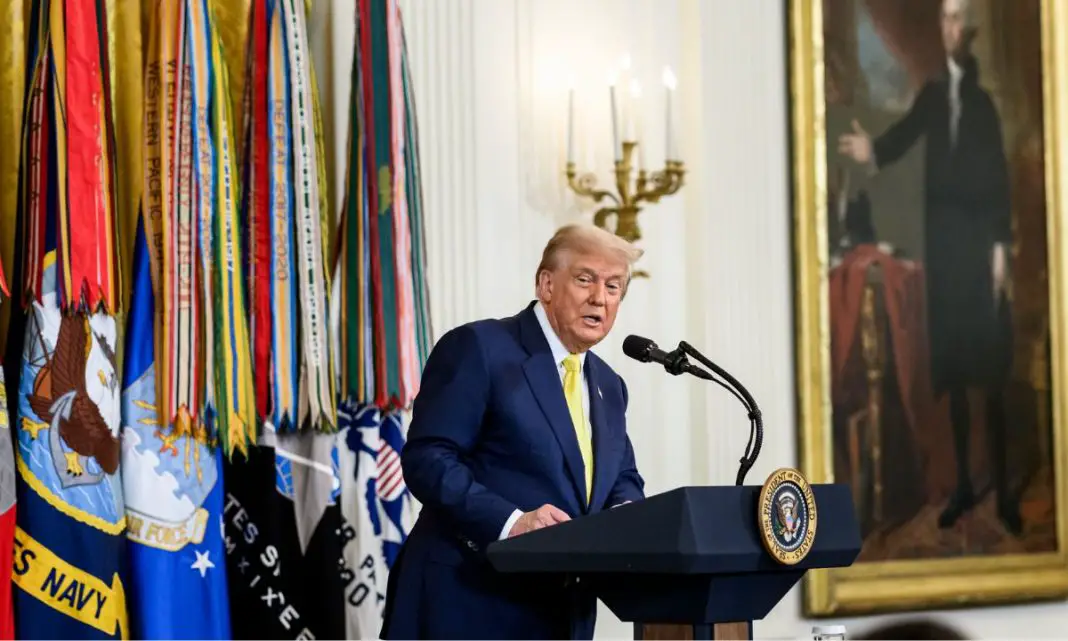

The Left hates to lose. But sometimes you just have to give it up.
And now a Democrat governor caved and handed Trump a massive victory.
When even a Democratic governor in a deep-blue state decides that parents deserve more options than a union-run monopoly, you know the ground is shifting. New York Gov. Kathy Hochul announced Friday that she is signing the Empire State onto President Trump’s school choice program, over the loud objections of the teachers unions that have long treated education policy in Albany as their private property.
The vehicle is the Education Freedom Tax Credit, also called the Federal Scholarship Tax Credit, created under the One Big Beautiful Bill. It allows individual taxpayers to claim a dollar-for-dollar federal tax credit of up to $1,700 for donations to nonprofit scholarship-granting organizations. Unlike traditional voucher programs, it does not draw directly from state or local public school budgets. Taxpayers simply redirect part of what they would owe the federal government toward scholarships for students.
There is a catch, and it is the reason Hochul’s decision matters. State governors must formally opt in before their residents and local education groups can take part. That meant a governor who needs union support in an election year had to decide between a program that helps working families and the preferences of the people who bankroll her party. She chose the families.
“Every parent wants their child to have a great education and the best possible chance to succeed. That’s what guides my decisions as Governor,” Hochul said Friday. She tried to soften the blow to her union allies right away, saying, “New York’s public schools are the backbone of communities across this state. That’s why I’ve made historic investments in public education, increasing school funding by more than $10 billion and fully funding Foundation Aid for the first time.”
The unions were not buying it. A coalition of teachers unions and public school advocates launched a petition demanding that Hochul reject the program outright. “Gov. Hochul plans to opt New York in starting in 2027. But most New Yorkers haven’t even heard of this program or know how it will affect New York,” the petition states. “Tax dollars would help pay private tuition for families who never used public schools.” Read that carefully: the objection is that families who have given up on public schools might get help paying for something else.
Supporters see it very differently. Sydney Altfield, founder of Scholarships for All and CEO of Teach Coalition, told Fox News Digital, “This is a tremendous day for New Yorkers. Millions of children across our state will now have access to scholarships that can help pay for tutoring, after-school programs and other educational needs.” She added, “Governor Hochul has kept her promise to New York families, helping put money back into the pockets of hardworking parents while expanding educational opportunities for children across the state.”
Hochul insisted she has been consistent from the start. “I’ve been clear from the start that New York would participate in the federal scholarship tax credit program if, and only if, all schools and students, including those in our public schools, could benefit. After a careful review of the federal regulations, we believe this program has the potential to bring millions of additional dollars to New York students and families without taking a single dollar from public schools or our state or local budgets,” she said.
Then came the line that tells you where the political winds are blowing. “I’m not going to leave money on the table when it could help our kids,” Hochul said. She added that she has been engaging directly with business leaders who have committed to use the program to support public school students and academic needs, and pledged that her commitment to public education “has not changed, and it never will.”
The Treasury Department and the IRS issued proposed regulations on October 1 to implement the program, clearing the way for what the administration describes as America’s first nationwide school choice framework. According to the IRS, more than half of the states have already signed up. Kentucky formally joined after its legislature overrode Gov. Andy Beshear’s veto of opt-in legislation, a reminder that voters and lawmakers are ahead of some governors on this issue.
A top Department of Education official told Fox News Digital that “competitive pressure” will push blue states to join, because residents will watch private donations flow to scholarship organizations in neighboring states and ask why their own governor is standing in the way. Education Secretary Linda McMahon has said some Democratic leaders have resisted simply because “it’s a Trump measure.” Hochul’s decision suggests that resistance is hard to sustain once parents notice what is on offer.
The backdrop makes this more than a technical policy debate. Major blue-city school districts have struggled to hold on to students since the pandemic, as parents who got a close look at remote learning and closed classrooms went looking for alternatives. Charter schools, private schools and homeschooling have all grown, and plenty of Democratic officials have been forced to rethink positions they once treated as untouchable.
For decades, school choice was a third rail in Democratic politics because it threatened the teachers unions, which pour enormous sums into liberal causes. A recent watchdog report estimated those unions funnel more than a billion dollars into political activity. When a governor with that kind of pressure bearing down on her still decides to opt in, it says something about how much the argument has changed among ordinary voters.
None of this means the fight is over. The petition drive shows the unions are prepared to keep pressing, and Hochul has stressed that she will oversee how the program works in New York. Opponents will argue about the details for months. But the principle has now been accepted by the governor of one of the most reliably Democratic states in the country: parents who want more choices for their children should not be blocked by a political machine that benefits from the status quo.
Hochul’s decision lands as a clear win for families who have long felt trapped in schools that were not working for them, and a pointed lesson for any Democratic governor still weighing whether to follow. Taking the side of parents turns out to be good policy and, increasingly, good politics too.
