
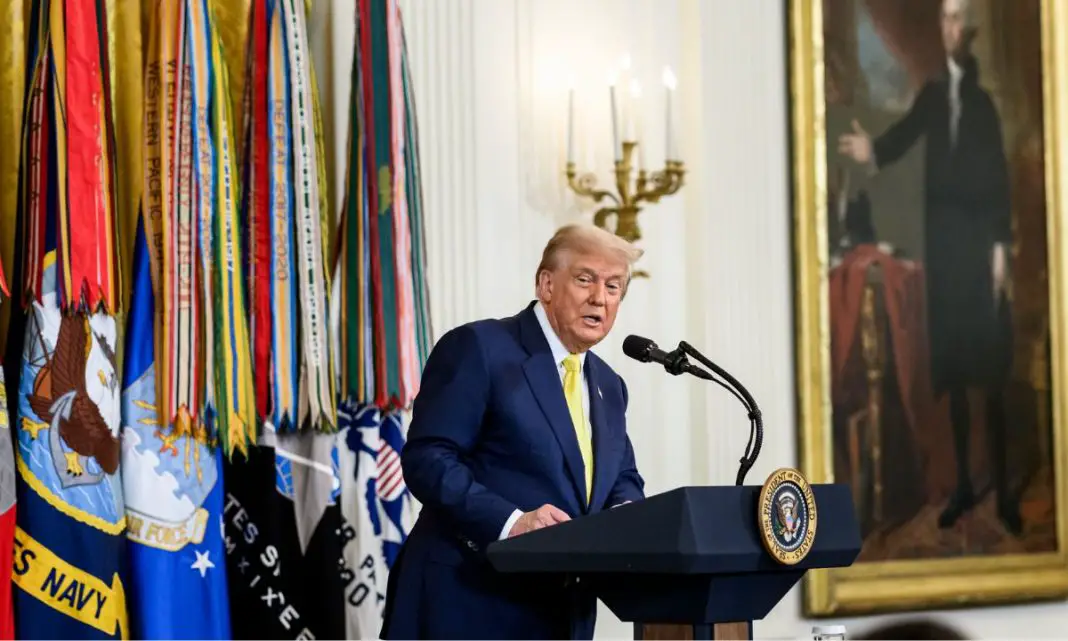

President Donald Trump appeared on Sean Hannity’s show Thursday night and delivered a blunt assessment of one of the most sensitive issues facing American higher education and national security: the flood of Chinese students into our universities.
While acknowledging deep suspicions about Beijing’s motives, Trump warned that simply shutting the door could deliver a devastating blow to many American colleges and spark an aggressive response from China itself.
The president laid out the practical realities. Hundreds of thousands of Chinese nationals currently fill seats in U.S. classrooms, bringing substantial tuition dollars with them. Trump highlighted the sheer scale of the issue, noting it involves roughly half a million students.
“As far as the students, it’s 500,000 students that come, good students. I could tell them I don’t want any students. It’s a very insulting thing to say to a country. They would then immediately go out and start building universities all over China,” Trump explained.
He painted a stark picture of what would follow if those students vanished overnight. Many American institutions, particularly those outside the elite tier, have grown dangerously dependent on this foreign enrollment to stay afloat financially. Removing it could trigger widespread closures and financial ruin for schools that already struggle.
“But if you want to see a university system die, take a half a million people out of it. And the ones that won’t be hurt are the top schools. The top schools will do fine. But your lower schools, your lower — the ones that don’t do quite as well, those schools, they’ll be dying all over the place,” Trump stated.
This reality exposes a rotten dynamic in American higher education. For years, universities have chased international tuition revenue while American families face sky-high costs and crushing student debt.
Hannity pressed the core security concern that millions of Americans share. Chinese students, particularly in STEM fields, often return home with knowledge and skills that directly bolster the Communist Party’s military and technological ambitions. Espionage cases and intellectual property theft linked to Beijing are well-documented.
“I think people would argue, they worry about do they have nefarious intentions,” Hannity noted.
Trump did not dismiss those fears. He recognized the two-way gamesmanship between the nations and admitted the student issue sits on a knife’s edge. Yet he also stressed the heavy price America would pay by acting too hastily.
“Sure, I know, and we worry about that. And, honestly, they do things to us and we do things to them. It’s a very, very fine line, the whole thing with students. So, they have 500,000 students, and our university system does great, it does great, you want to screw it up? Take a half a million students out. And you’re going to see bankruptcies at the lower end of good colleges, but they’re not known or whatever, you’re going to have a lot of problems,” he continued.
The president made clear this remains an active consideration in his thinking. No easy answers exist when balancing economic fallout against genuine threats from a strategic rival. Universities themselves, he observed, resist any disruption to the current arrangement.
“So, it’s something I’m always looking at. But it’s a very insulting thing to tell a country we don’t want your people in our schools, it really is. Now, a lot of people say, oh, that’s a terrible thing, it is a very insulting thing. … But I will tell you that school systems don’t want that to happen, because you won’t have much of a school system,” Trump added.
This situation highlights how elite academia has drifted far from its supposed mission. Many institutions function more like businesses chasing full-fee-paying foreign customers than centers dedicated to cultivating American talent and preserving Western values.
Lower-tier schools serving regional populations get caught in the squeeze, while Ivy League endowments swell.

Exactly what was puzzling?
These foreign students pay the inflated tuition and that has caused these universities to raise tuition rates for American students and our government needs to begin to cut all foreign students at least by 20% every year until they begin to number less than 1% of the student body of each university.
The problem is Chinese are getting into our Stem programs while the Americans can’t because the Chinese are sitting in those chairs and going back home with the knowledge American students can’t get. That means our society can’t move this country ahead in the important areas, but the Chinese country can. Who were these colleges and universities built for any ways, for foreigners or for American citizens. It is not the job of this country to give foreigners a great education that can be used against us in the future. It is the job of this country to get our kids in those important seats so our kids’ knowledge can be used to protect us in our future. It’s the same way with these illegals. They come in and park themselves long enough for their kid’s whether born or not here, get free elementary through high school and college education ahead of citizen kids. Remember the dreamers. They received jobs and free education through college with citizen offer; but very few of them actually applied for citizenship. However, they continued to send their pay checks back to families in the countries where dreamers remain citizens of. For these illegals and the Chinese, “Something smells rotten in Demark.” or maybe the old saying should be “Something smells rotten in the U.S.”.