
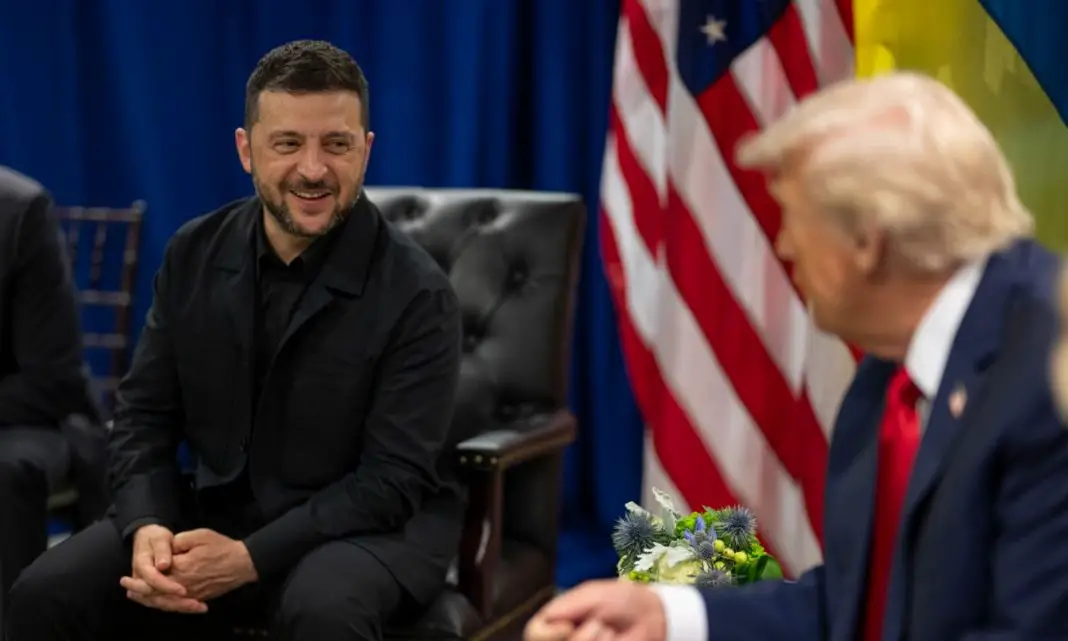

Emerging Security Guarantees
On Monday, President Trump and top U.S. officials announced progress toward a comprehensive peace deal to halt the Ukraine conflict, incorporating NATO-style protections, a massive reconstruction initiative, and potential joint management of Europe’s largest nuclear facility.
The aim, according to administration sources, is to deliver an arrangement that deters further Russian advances while providing Ukraine with unprecedented defenses against potential future threats—with Trump describing the talks as advancing significantly.
Yet Ukrainian leaders noted that critical specifics are still unresolved.
“President Trump’s very focused on reaching a conclusion to this conflict that really stops the Russians from moving west,” a senior U.S. official told reporters Monday.
“Under President Bush, Russia moves west. Under President Obama, Russia moves west. Under President Biden, Russia moves west. President Trump really wants to see this as an agreement that ends that for good,” the official added.
The envisioned protections would feature oversight, validation, and enforcement measures to block any renewed Russian incursion.
“The basis of that agreement is basically to have really strong guarantees — Article Five-like — also very, very strong deterrence,” the official said.
Trump informed journalists that “Russia wants to get it ended” and that discussions have involved direct contact with President Vladimir Putin.
“The problem is they’ll want to get it ended, and then all of a sudden they won’t; and Ukraine will want to get it ended, and all of a sudden, they won’t,” the president said during an event honoring border enforcement officials.
“We’re getting closer,” Trump also said. “We’re having tremendous support from European leaders.”
Specifics remain limited, though the proposal would likely need congressional ratification.
“President Zelensky spoke about flaws in past agreements, and we discussed ways to make sure a future deal learns from those mistakes and leads to a proper, enduring agreement,” the official said.
The president is prepared to pursue legislative approval but emphasized the time-sensitive nature of the proposal.
“Those guarantees will not be on the table forever,” the official said, urging Kyiv to act swiftly.
Another administration source described the protections as the most robust offered during extended negotiations.
“Anything we felt needed to make the Ukrainian people feel safe is included in this package,” the official said.
Even with the positive tone, precise elements of the protections—essential for Ukraine to consider compromises—continue to lack clarity, even among Kyiv’s leadership.
Ukrainian Perspective and Recent Negotiations
Zelensky, in an X post, stressed that “before taking any steps on the battlefield, both the military and the civilian population must have a clear understanding of what the security guarantees will be.”
“We are working on putting all of this on paper right now, and there is progress,” he said. “The details developed by the military part looks quite solid, even though this is only the first draft.”
The Ukrainian leader shared some of the U.S. officials’ cautious optimism, expressing appreciation for Washington’s attention to Kyiv’s priorities.
“It is very important that our counterparts from the United States of America heard all the details regarding the war,” he said. “If these meetings had taken place earlier, the progress would have been even greater. But I am grateful that we truly worked very well together.”
This shift follows the administration’s move away from separate envoy missions to Russia and Ukraine, along with Jared Kushner’s involvement in the talks.
Still, he said that “there are some things that, in my view, are destructive and would definitely not help us.”
“It is important that they are no longer present in the new versions of the documents,” he said, without giving details. “This matters, because dignity matters.”
The developments follow intensive sessions in Berlin involving U.S. representatives Steve Witkoff and Jared Kushner with Ukrainian and European counterparts since Saturday—including an extended eight-hour discussion with President Zelensky.
The meetings featured security advisors and diplomats from Germany, Britain, France, and additional European countries. Sources noted strong European commitment to resolving the war.
“I would assess that it was really, really positive in almost every respect,” one official said, adding that Trump is “really pleased with where we are today.”
Key Challenges and Path Forward
Territorial issues continue to pose the greatest obstacle. Moscow seeks Ukrainian withdrawal from Donbas regions, including areas it has not fully controlled despite years of efforts.
Zelensky recognized differing views on land, stating they “must be acknowledged and discussed openly.”
“I believe that the American side, acting as a mediator, will propose various steps to try to find at least some form of consensus,” he said.
“We will do everything possible to find clear answers to questions about security guarantees, territories, and money as compensation for Ukraine to rebuild. It is necessary to understand the source of this funding.”
Upcoming military discussions are planned to refine elements, per a Ukrainian source. “We brainstormed options, including an economic free zone, and tried to define how it would operate,” a US official said.
Talks also explored leveraging seized Russian funds for reconstruction, with specifics ongoing.
Progress was noted on the Russian-occupied Zaporizhzhia facility. “There’s still a gap on how it should be operated,” one official said, “but both sides want it repaired and functioning.”
“And it seems we’re close to a 50/50 split of the power plant,” the official added. “That would be a good outcome for Ukraine’s energy security.”
Should it come together, the deal would merge robust U.S. defenses with extensive rebuilding aid and co-management of the key power station—a bold structure to secure lasting stability, restore the nation, and permanently curb Russian expansion westward.
Though Moscow has not yet responded publicly, U.S. sources expressed confidence that Russia would endorse the approach.
Do you think the Russia-Ukraine war will end soon? Let us know your thoughts in the comments section below!

Baji555live, you want live action right? Well, let’s see how it plays out, but with live action, it’s often exciting. Hop in right here: baji555live
Heard about isbetjogodeaposta. Sounds kinda exotic. Might take a peek. Could be my new favorite spot! See the exoticness by yourself isbetjogodeaposta.
123wincom30? Another one bites the dust… or maybe not! Worth a quick look at least. Are their bonuses any good tho’? I wonder. 123wincom30
BC777login is my secret weapon for those days when I need a little excitement. The interface is slick and the games are great. Dive in at bc777login. You’ll be hooked!
BBQ999 is where the fun never stops! I’ve had some seriously good times here. Check it out for yourself at bbq999. Bring your A-game!
B955gamedownload is legit! Downloading games has never been easier, and the selection is impressive. Give it a shot at b955gamedownload. Get ready to play!